One you packed
Most reliable meal
Travel
The dining questions do not change because the kitchen is in a roadhouse. This guide is about planning, packing and asking — not about a ranked map of “halal towns”.
At a glance
One you packed
Most reliable meal
Ask, or skip meat
Roadhouses
Request, then verify
Flights
Smartraveller
Overseas
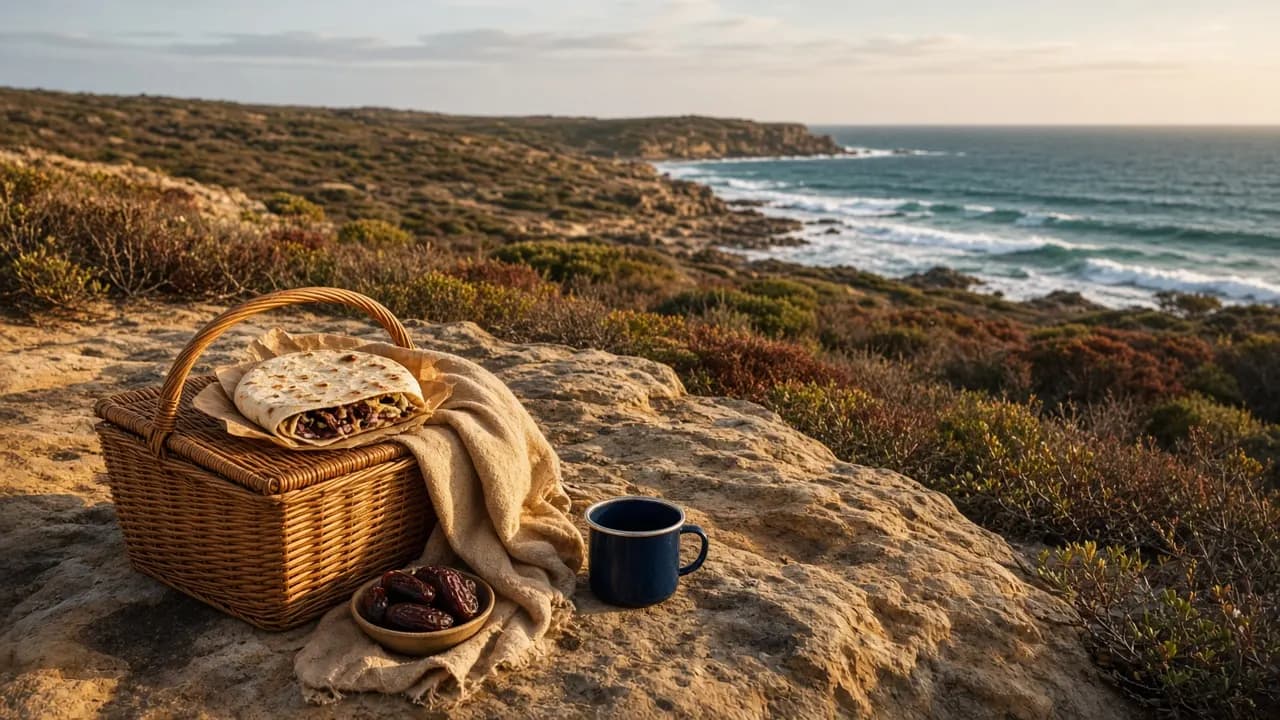
The most reliable travel meal is the one you packed. That is not a slogan against Australian hospitality. It is a recognition that a new kitchen is a new set of unknowns, and that this website does not operate those kitchens.
Travel on a halal diet inside Australia is mostly logistics: hours between towns, the limits of a roadhouse grill, the difference between a ferry kiosk and your own container, and the fact that a flight menu is printed before you board.
Before you leave:
We will not tell you how many kilometres it is between two unnamed towns as if that were a national statistic. We will not tell you that a particular chain is “safe”. We will not invent a festival calendar.
Long Australian drives create the same problem every time: you are hungry in a place where the staff did not expect a theological interview. Be brief and specific. “Does the gravy have pork or alcohol?” is enough. If the answer is a guess, eat the chips you asked about, the salad without dressing, the eggs, or the food in your bag.
Service-centre photographs on a phone are advertising. A pie warmer is not a certificate. If you need meat, you needed a plan before you passed the last supermarket.
A cooler with yoghurt, fruit, bread, and leftover lemon-herb chickpeas will out-perform a hopeful search for a sticker on a bain-marie. That is household practice, not a health claim.
Do not use this site as a city index. If a friend names a place, that is their testimony, not ours. If a venue uses the word “halal” on a window, treat it as you would in your home city: a claim to verify.
Markets and food halls multiply the problem because one table’s fryer is not another table’s fryer. Ask at the stall you are actually buying from.
If you are visiting family who do not share your diet, the home-kitchen essay is more useful than an argument. You can offer to cook. You can shop. You can explain the four dining facts without giving a lecture on export law.
Airlines sometimes allow a special-meal request. That request is an operational label. It is not AGAHP. It is not a personal ruling. If the meal arrives and you cannot tell what it is, you still have the snack you packed.
Airport retail is ordinary retail: read the packet. FSANZ’s point still holds — a religious word on a sandwich box is voluntary and must not mislead, but many boxes will not have the word at all. You do not need the word to eat fruit.
We will not publish a table of airline codes or a price for an extra bag of food. Those change, and we do not invent them.
Closed food service is a short menu. Read it as a list of ingredients, not as a culture. If the only hot food is a beer-battered item and a meat pie of unknown filling, you already know what you packed for.
Water is still water. Dates still travel. Bread still travels. The Ramadan page matters if your movement coincides with fasting hours; a pre-dawn meal and a plan for sunset are part of the itinerary, not an afterthought.
This site is an Australian food guide. Once you leave, food rules, import limits and local markets are not something we will invent. Official Australian travel advice lives on Smartraveller. Biosecurity rules about what you may bring back are a departmental matter of a different kind — do not confuse them with AGAHP, which is about export meat certification.
If you carry food out, check the destination’s rules. If you carry food in, check Australia’s. Those pages are primary. This paragraph is only a signpost.
Do not expect a map pin. Do not expect “best halal city” copy. Do not expect us to republish an operator’s tour itinerary. The quality-bar site this rebuild is measured against can talk about a specific lighthouse because that is its subject. Our subject is a diet, not a ticket office. We will not fake a venue in order to sound like a guidebook.
Travel is still supposed to be pleasant. The method is the same as Tuesday night: name the food, ask the source, keep a backup, and do not outsource the decision to a stale list.
We will not name brands. We will name categories that survive a long day in a bag:
That list is boring on purpose. Travel writing that depends on a secret café is advertising.
The same-day return. You can eat breakfast at home and carry lunch. Dining questions only appear if you stay out for dinner. Do not invent a need for a city guide.
The overnight in a town you do not know. Shop on arrival if a supermarket is open. Cook in a cabin if you have a kitchenette. Use the dining questions once, calmly, if you must eat out. The kitchen essay still applies to a rented bench.
The multi-day tour. You will be tired. Tired people accept guesses. Write the six dining questions on paper. Eat the backup food when the guess arrives. See Ramadan if fasting hours overlap the itinerary.
A shared hostel kitchen is a dining-out problem with extra boards. Wash what you use. Do not store pork-adjacent food against yours if you can avoid it. Label your box. You are not policing other travellers. You are keeping your own ingredients identifiable — the same integrity idea the department uses in a very different industrial setting.
Hotel breakfast buffets are trays without authors. Eggs, fruit, and plain yoghurt are usually askable. Sausages and “mystery mince” are not. A made-to-order omelette is a better conversation than a bain-marie.
There will be no “halal trail” from this domain. There will be no pin dropped on a named operator. There will be no claim that a region is “easy” or “hard” as if we had surveyed it. Those claims need data we do not have and will not invent.
If a local friend offers a name, that testimony is theirs. Our job is the method you take into the next town after that friend has gone home.
People ask whether one Australian region is “easier”. We will not answer with a ranking. Produce is widely available. Meat questions follow you. A coastal town with excellent tomatoes does not cancel a fryer question. An inland town with one café does not cancel a packet of oats in your bag.
If you are visiting a farm gate, you are often looking at plants. Plants are the easy case. If you are visiting a meat business, you are looking at a process. Ask, or do not buy. This website will not pre-clear the gate.
Fuel, water, and shade are travel facts that are not dietary facts. We mention them only to say: do not let a religious question make you skip water. Water is permissible. Drink it.
If the bag has water, fruit, and a leftover pot, you can leave. Everything else on this page is a way to stay calm when the bag is empty.
If you remember one travel sentence, remember the bag. A town cannot inherit a certificate from a website you read at home. Carry the meal you already accept, then ask if you must buy another.
If you forget the bag once, you will remember the next time. That forgotten hour is not a reason to publish a city ranking. It is a reason to put oats in the glove box before the next dawn departure.
If you travel with children, pack their known food first. A hungry child will accept a guess faster than you will. The dining card still fits in a pocket. The leftover pot still fits in a bag. The town still does not need a ranking from us to be visitable.
Pack food you already accept, treat unfamiliar kitchens as places to ask specific questions, and do not rely on a website list of certified venues.
They are a request, not a personal certificate. Confirm ingredients when you can, and pack a backup for delays.
No. Lists go stale and read as endorsements.
Official destination advice is on Smartraveller. This page stays on food planning.
A roadhouse can still feed you well after a good question. It cannot inherit a certificate from this page.